Can You Do This Yourself
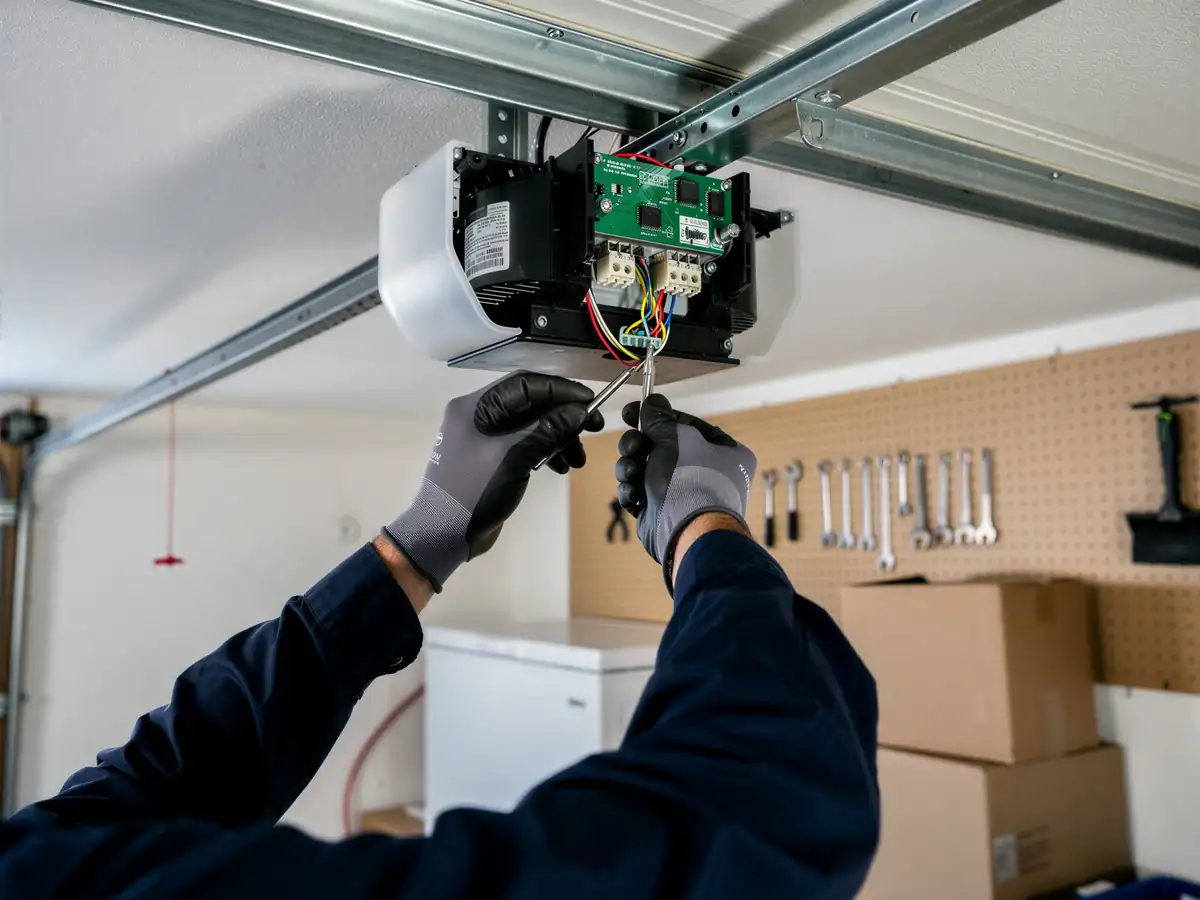
Some of it, yes. If the remote stopped working, swap the battery before you call anyone - it sounds obvious but it's the single most common reason an opener "dies" overnight. If the wall button lights up but the motor doesn't run, check the breaker. Those are five-minute jobs. Where we'd tell you to stop is anything involving the drive gear, the logic board, or the sensor wiring behind the motor housing. On a unit that's been running since this neighborhood's original construction wave, the plastic gear is often already hairline-cracked, and removing the cover to "just look" can finish the job for you. Travel cord adjustments and sensor realignment are also easy to get wrong in a way that disables the safety reverse, which isn't something to guess at. If you're comfortable with a screwdriver and a multimeter, a battery or breaker check costs you nothing. Past that, you're better off having someone who's pulled a few hundred of these covers off doing it.
What Is on the Truck
Because Lancaster's housing runs through that 1990 build era, the truck carries parts sized for openers from that window forward: drive gear and sprocket kits for chain-drive units, belt segments for the newer swaps homeowners have already made, logic boards for the common residential brands sold through the '90s and 2000s, and replacement safety sensor pairs. We also carry a stock of remotes and keypads, since those fail independent of the motor and get replaced more often than people expect. What we don't carry is a parts bin for every opener ever made - a unit original to a 1990 house that was never upgraded sometimes uses a motor or board that's been discontinued, and in that case we tell you straight that repair isn't the economical route.
The Symptom
The call we get most from this part of the service area is the motor running - you can hear the hum - while the door itself doesn't move, or moves an inch and stops. That's a stripped nylon drive gear, and it's the predictable failure point for an opener that's been cycling since somewhere in the 1990 to early-2000s window, which covers a lot of the units still in place here. The gear is a plastic part by design, meant to wear before the metal rail or motor does, and on a household that's used the garage door as the main entry for 30-odd years, it simply runs out. Less often we see a door that won't close at all and just reverses - that's a sensor alignment problem, sometimes from nothing more than a bump during yard work. Either way, the fix is specific to what's actually broken, not a blanket opener swap.
What Can Go Wrong
The honest limitation: if your opener is original to a Lancaster house built right around 1990 and was never replaced, we sometimes can't get the exact board or motor housing anymore. In that case we won't force a repair just to bill one - we'll tell you a new opener is the better money, especially against a 30-plus-year-old unit that's already shown one failure and will likely show another within a year or two. On the household budget side, with median income in this area around $67,584 across roughly 14,648 households, that's a real decision point for a lot of families here, and we'd rather give you the gear-replacement option first if the rest of the unit is sound. Where it can go wrong on our end is misdiagnosing a sensor issue as a board issue - we check sensors first precisely because that mistake costs you money for nothing.